Burberry Omnichannel Growth Strategy: Rebalancing Distribution Channels & Digital Campaign Repositioning
A data-driven brand repositioning and growth blueprint evaluating pricing elasticity, off-price outlet margin dilution, and advanced conversion metrics across digital experiential campaigns.
Brand Values & Heritage
The Legacy of gabardine
Founded in 1856, Burberry built its luxury prestige on a foundation of weatherproof innovation (inventing gabardine) and signature check patterns. Guided by a core purpose of "Creativity Opens Spaces," the brand positions itself around four value dimensions: creatively driven, proud of heritage, open and caring, and forward-thinking.
However, Burberry faces a critical product-mix challenge. While heritage trench coats and scarves maintain strong, high-margin customer demand, the brand’s bag category struggles to achieve bestseller status. This deficit is caused by fierce market competition and strategic fatigue surrounding the brand's luxury repositioning.

Market & Industry Audit
Through rigorous industry analysis, we evaluated Burberry's market position across core global channels. While strengths include an iconic brand image and a global footprint spanning over 400 stores, significant structural risks remain.
Royal warrants, unmatched outer apparel prestige, and advanced online-offline integration across major cities.
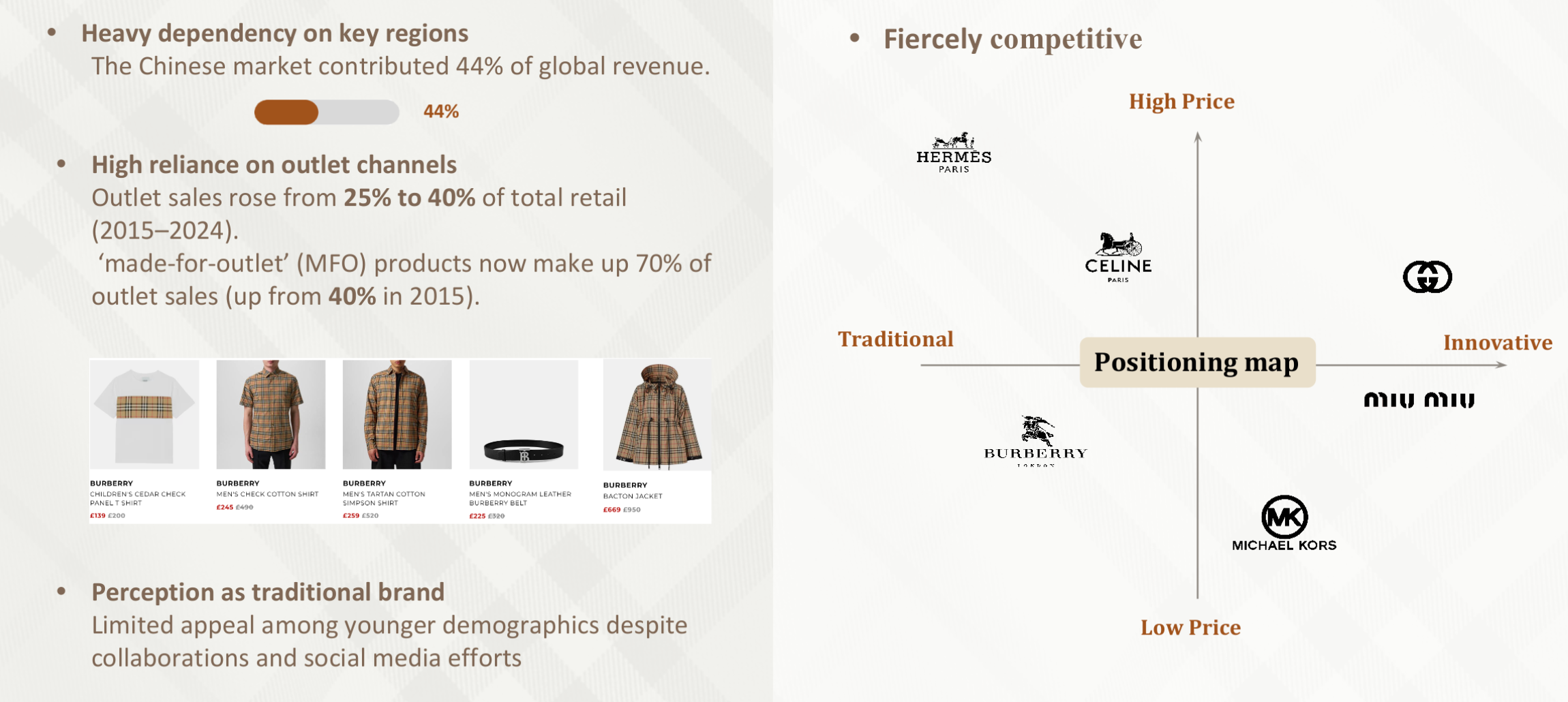
Heavy dependency on specific geographic regions (China alone drives 44% of revenues). High reliance on off-price outlet pipelines.
Expanding into emerging luxury markets (APAC spending is rising at a 3–4% CAGR). Increasing Gen Z purchase shares (projected at 25–30% of total luxury by 2030).
Fierce competition from luxury players (Miu Miu, Celine, Hermès) capturing younger, avant-garde cohorts.
Evaluating the Outlet Exposure Risk
A critical vulnerability identified in our audit is Burberry’s reliance on discount channels. Between 2015 and 2024, outlet sales surged from 25% to 40% of Burberry's total retail footprint. More alarmingly, "made-for-outlet" (MFO) lower-cost product lines expanded to comprise 70% of all outlet sales (up from 40% in 2015). This reliance on discounted channels undermines Burberry’s luxury prestige, creating a perceived conflict with full-price boutique offerings.
Campaign Auditing
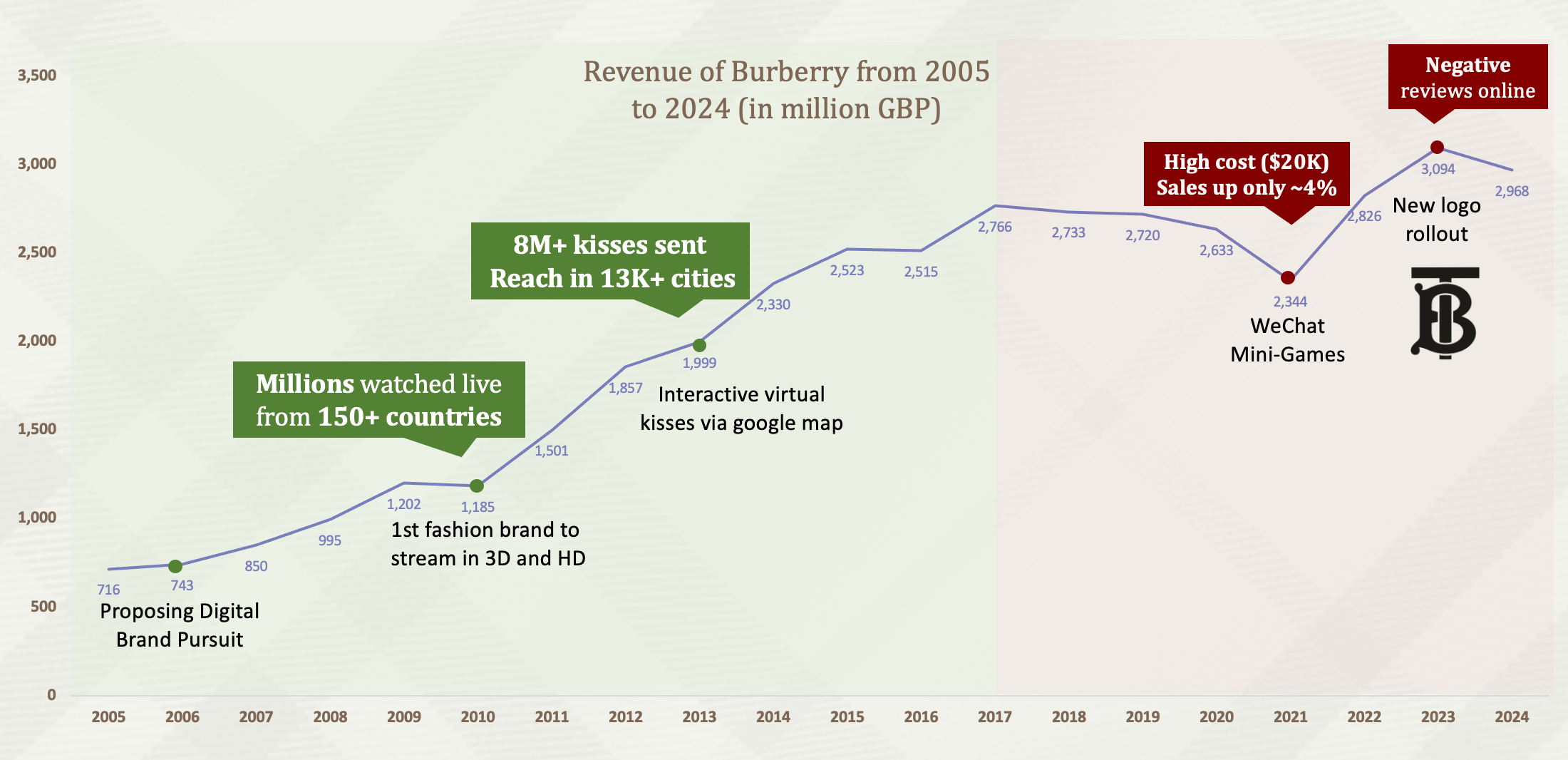
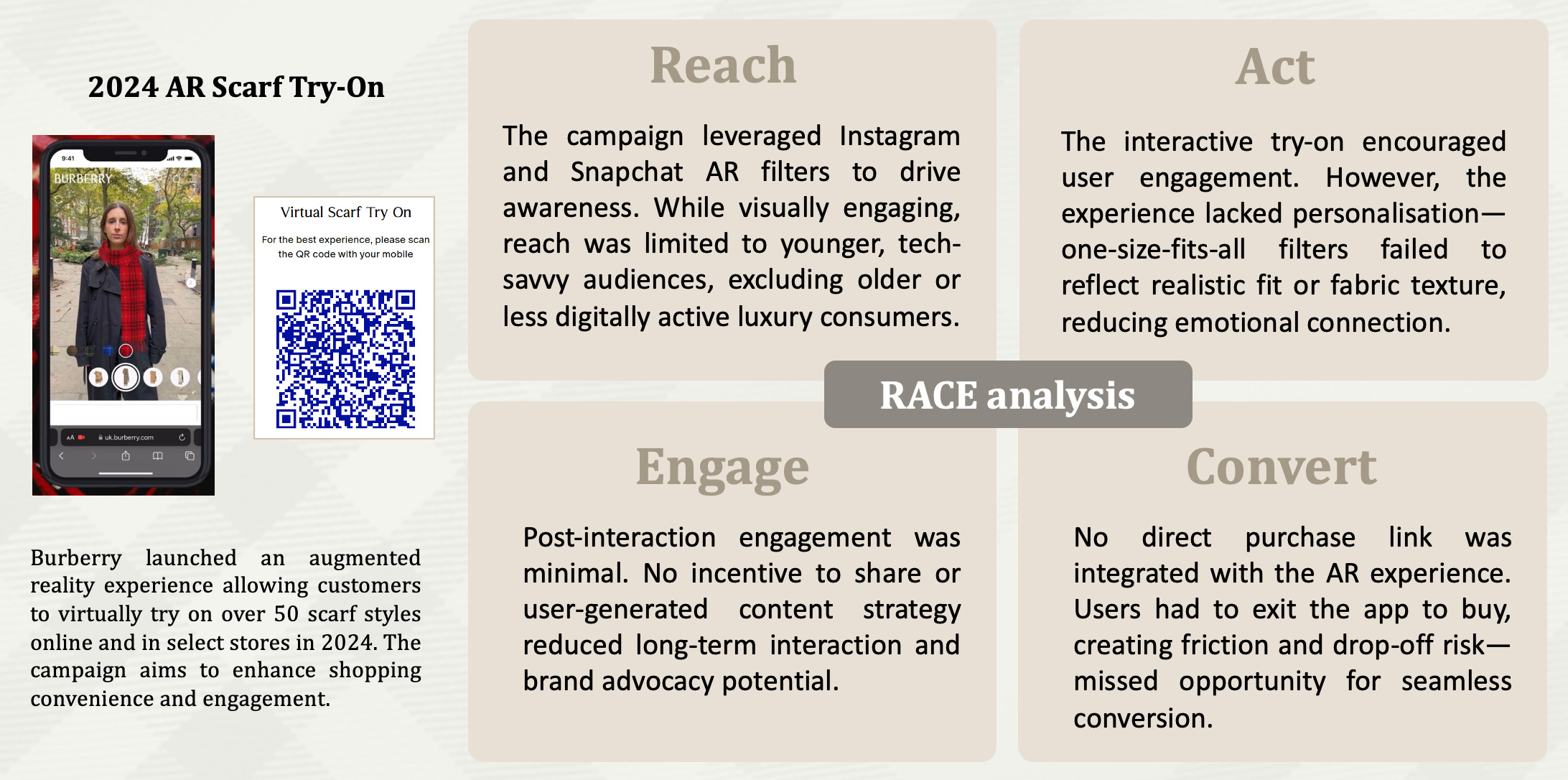
Burberry was a pioneer in luxury digital innovation, famously being the first fashion brand to stream in 3D and HD. However, recent campaigns show strategic fatigue, as evaluated via the RACE framework on the 2024 Augmented Reality (AR) Scarf Try-On:
Leveraging Snapchat and Instagram AR filters achieved quick visibility but restricted the campaign to tech-savvy Gen Z cohorts, entirely omitting older, high-spending full-price buyers.
While engaging, the filters lacked tactile fidelity. A one-size-fits-all model failed to represent realistic fabrics and scarf drapes, weakening luxury emotional connection.
No direct purchase link was integrated into the AR lens. Customers had to manually leave the social application and navigate to uk.burberry.com to purchase, creating high drop-off rates.
There was a lack of structured incentives for user-generated content or follow-up rewards, reducing long-term advocacy potential.
Dilution Sandbox
To evaluate how channel configurations affect brand luxury status, adjust the sliders below to simulate the relationship between Outlet Sales Share, Made-for-Outlet (MFO) SKU ratios, and overall Brand Equity Index:
{
  "channel_dilution": "HIGH",
  "recommended_action": "Reduce Outlet dependency to under 25% immediately to safeguard gabardine full-price positioning."
}
Strategic Retrospective
Commercial Strategy Audit & Reflections
Evaluating Burberry's channel dynamics highlighted a core luxury business truth: exclusivity is the true driver of luxury margins. Expanding outlet dependency to offset short-term revenue slowdowns creates brand dilution that compromises full-price boutique authority.
Core Capabilities Enhanced
- Pricing Elasticity Valuation: Enhanced my ability to analyze how made-for-outlet production compromises high-end brand equity.
- Advanced Campaign Repositioning: Formulated structured recommendations to optimize mobile AR channels with direct e-commerce checkout handshakes.
- Strategic Asset Curation: Learned to align digital promotional campaigns with high-margin core categories (such as trench coats and scarves) to drive conversions.
Proposed Solutions
To stabilize Burberry's market positioning, we propose cutting MFO outlet SKUs by 50% and reorienting the digital influencer strategy. Shifting from volatile celebrity endorsements to professional fashion and craft creators will better communicate the raw heritage and technical handiwork behind Burberry's iconic pieces.